Marit Olsen
The Leopard (Jo Nesbø Edition)Marit Olsen is a Norwegian parliamentarian and murder victim whose killing at Frognerbadet turns a private death into a public spectacle. Her murder appears to connect her with a series of killings, but the physical evidence and later reconstruction make her case a deliberately confusing clue: it attracts attention, invites suspicion about her marriage, and is used to pressure investigators into recognizing a pattern.
Identity and private life
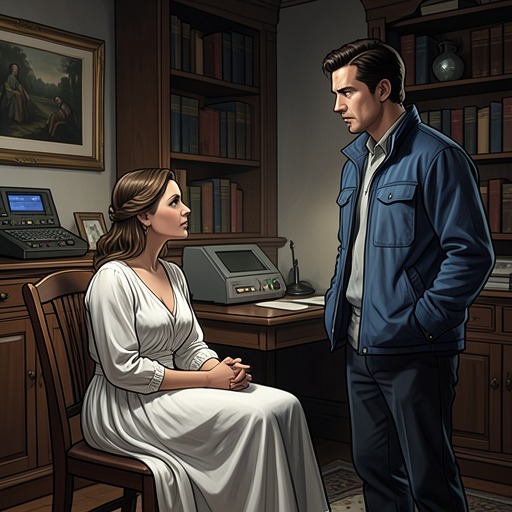
Marit loves skiing in the mountains but hates jogging. The contrast is not simply between two forms of exercise: running makes her acutely conscious of how her body appears to other people. After only a few hundred metres she is out of breath; she imagines the ground trembling under her steps and sees herself through the imagined gaze of passers-by, focusing on her double chin, the movement of her body beneath her tracksuit, and the helpless look of an overweight person exercising. The account presents this self-scrutiny as a reason she tries to avoid an audience, not as evidence that she is unwilling to be active.
She schedules her three weekly runs through Frogner Park for ten at night, when few people are around. The hour and the park’s scattered lamps offer some concealment, though not complete privacy. During one run she stumbles forward into the light and onto the road. Her stomach hits the asphalt, and she slides and rolls onward before coming to rest with road dust in her mouth and small, stinging stones in her palm. The episode gives physical form to the exposure she has tried to avoid: the body she fears others will judge is suddenly brought down into the open. The text does not establish that this fall is connected to her later murder.
Marit is also Rasmus Olsen’s wife. He is described as thin, a contrast to the bodily self-consciousness that dominates her running episode, but the available evidence does not develop their domestic life beyond the investigation into their marriage and his movements around the time of her mountain trip. Her public position is clearer: she is a member of parliament, a fact that makes the crime scene a particular draw for journalists and onlookers.
The mountain trip and the questions around her marriage
Investigators piece together Marit’s movements through travel records rather than a registered train ticket in her name. They find a card payment made in the dining car of a train bound toward Ustaoset. The payment was recorded at 2:13 p.m., when the train was between stations and had not yet reached Ustaoset; it occurred the day before the date associated with Adele Vetlesen’s and Borgny Stem-Myhre’s tickets to the same destination. The transaction places Marit on the route, but the absence of a registered ticket leaves details of her journey uncertain.
A later reconstruction places her among the people at Hävasshütte, along with Elias Skog, Borgny Stem-Myhre, Charlotte Lolles, and Iska Peller, who is ill and sleeping apart from the others. That account is presented as a reconstruction, not as a complete, independently established record of every movement in the hut. The hut’s remote setting and the overlap among its visitors nevertheless make Marit’s trip important to the investigation’s attempt to connect separate victims and locations.
Rasmus becomes the subject of a possible theory when he acknowledges that, a few months earlier, he and Marit had experienced a small episode of jealousy involving a woman with whom he was said to have flirted. According to the account, Marit withdrew to Hävasshütte to think. Investigators wonder whether the trip might have involved retaliation rather than reflection. Rasmus had booked a room at a hotel in Ustaoset for the night in question, but his presence in the area raises further questions: whether he actually stayed there, whether he could have skied to the hut, and what he was doing nearby while Marit was there.
There is evidence both for and against suspicion of Rasmus. Telephone information indicates that he spoke with Marit that morning, which could have told him where she intended to go. The weather was clear throughout the night, making travel on skis possible. Yet the theory does not explain why he would have killed anyone other than Marit and a possible partner. These are investigative possibilities, not proof that Rasmus murdered her or that she had an affair.
Murder and public display
Marit’s body is found at Frognerbadet, the public swimming complex within Frogner Park. The police can seal off the fenced facility by running a cordon around its perimeter and stationing an officer at the entrance. Outside, reporters circle the scene, hoping to get close to the body. Her status as a parliamentarian increases the public appetite for images even as the police try to keep the site secure.
The murder’s physical details are exceptionally violent. A length of old-fashioned rope, twisted from linden and elm bast fibres and lacking elasticity, tightens around Marit’s neck and nape above the pool floor. Her body falls hard into the empty basin; the rope holds her head and neck, and the fall separates her head from her body. The head eventually slips from the noose, lands on her blue tracksuit jacket, and rolls across the tiles. The account emphasizes the abrupt return to silence in the bath after the fall. The scene is not merely a concealed killing: the location and the exposed body make it an unmistakable spectacle.
Her mouth bears a wound, but it differs from the puncture pattern found on earlier victims. Investigators have spent two months examining blood, hair, and fingernail samples and scrutinizing images, without finding a solution. They have developed twenty-four theories about the twenty-four holes in the mouth area of the earlier victims, which appear to radiate from a central point inside the mouth. Marit’s injury, by contrast, was made roughly and violently with a knife. The shared feature offers a possible link; the difference resists an easy conclusion that every wound was made in the same way.
Meaning in the serial investigation
Harry Hole argues that the three murders may have been committed by the same person or people and that finding a connection could reveal a motive. At this stage, that is an investigative hypothesis rather than a solved case. Marit’s murder supplies both a point of comparison and a distraction: the mouth wound resembles the earlier crimes in broad outline but not in execution, while the rope creates a traceable link to the Lyseren rope factory. That discovery prompts criticism that investigators began searching for a missing person at the very factory that supplied the rope used to kill Marit, and threatens Harry’s standing with the Ministry of Justice.
The investigation also has to correct a witness’s interpretation of the night at the hut. Elias Skog recalls seeing a woman and a man beneath the outhouse eaves, with the man holding the woman’s mouth as he pulled her inside. At the time, Elias mistook the scene for sexual activity; after reading about the murders, he reconsidered it as a possible crime. Kaja Solness explicitly rules Marit out as the woman he saw. The correction matters: proximity to the same hut does not make Marit the victim of every suspicious event witnessed there, and a vivid but mistaken account cannot safely stand in for identification.
A later account gives Marit’s death a further, calculated role. The killer murders Borgny and Charlotte, then kills Marit and displays her at Frognerbadet in an effort to force the police to recognize a connection among the women and find Tony Leike. When the investigation does not move as intended, the killer escalates, laying further traces and targeting Elias. Marit’s murder is therefore represented not only as an attack on an individual but as a staged signal whose intended audience is the police. Its prominence makes it seem like the key to the pattern; its differences and misdirection show how a conspicuous clue can also obstruct the search for the truth.